
10 August 2026
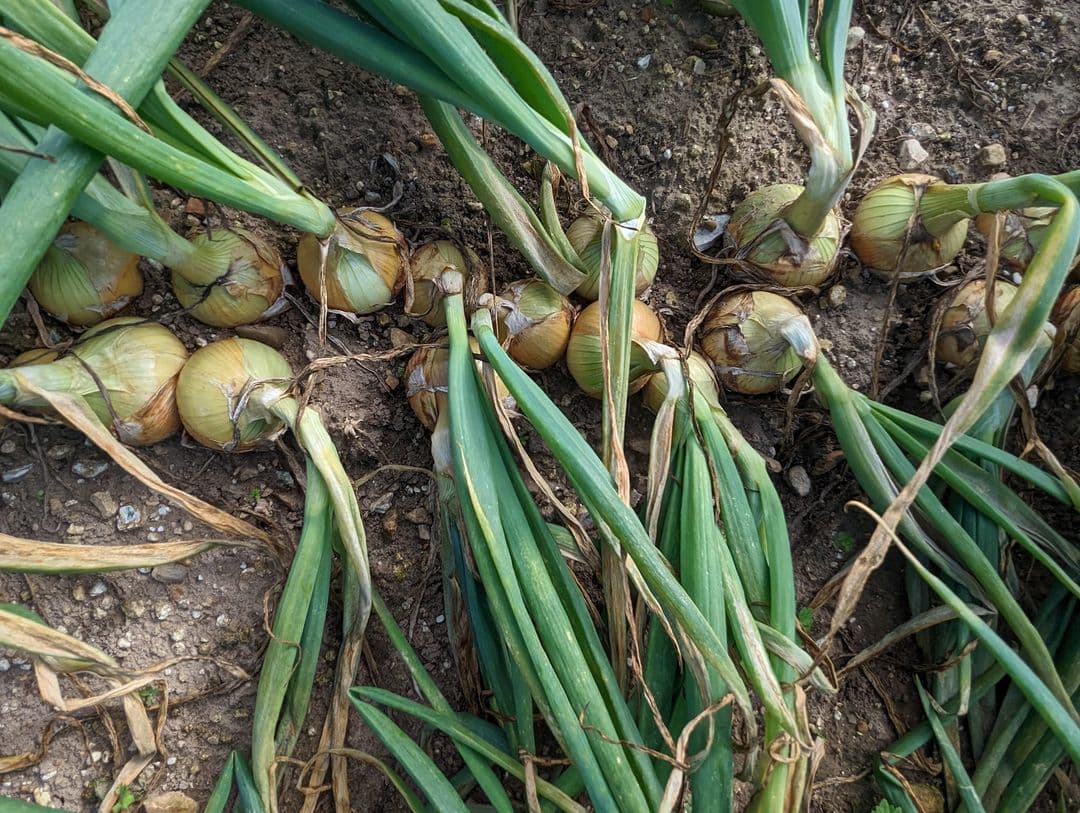
Ask any onion grower how the season has gone and you will get a version of the same answer. This has been the most difficult growing year in living memory, and the crop coming into store will show it.
The July grower reports from around the country make sobering reading. Record breaking June temperatures, the Met Office's first ever red extreme heat warning in Suffolk, and an exceptionally dry stretch throughout July and August that landed at exactly the wrong moment, just as the crop should have been bulking out. Some reservoirs are empty, others will be soon. Summer abstraction licences have been stopped.
A season with no water in it The rainfall numbers tell the story better than any commentary. One East Suffolk grower recorded 25mm in March, 3mm in April, 22mm in May, then 65mm in the first ten days of June and effectively nothing after that.
Set that against what the crop actually needs. Vegetable crops can use 6 to 8mm a day in hot weather, so a 25mm irrigation pass lasts three or four days. Most growers are kitted up to apply 25mm every six or seven days. The gap between what the crop wants and what the kit can deliver is where this season's yield went.
The crops that have come through in reasonable shape are the ones that had irrigation passes well into double figures. Sets have had around twelve applications. Drilled crops are running at ten to twelve. At £70 to £85 per acre inch, that is a substantial and largely unbudgeted cost sitting behind every tonne, and it is a cost that will rise as growers build new reservoirs and upgrade systems without grant support.
Where the water could not keep up, the picture is stunted canopies, small bulbs and crops that started to bulb early without the leaf area to fill them. Drilled maincrop is the biggest worry. Dried tonnages across the industry are running anywhere from 40 to 50 tonnes per hectare, and the heat has pushed a lot of drilled crops into rapid maturity with widespread canopy fall over.
Fusarium is the story of this season Heat and drought are a problem in themselves. What they do to disease pressure is the bigger problem.
Fusarium oxysporum f.sp. cepae, Fusarium Basal Rot, thrives on stressed roots and high soil temperatures, and this summer has handed it both. Agronomists are now finding infected plants in most fields. Growers are already hearing of badly infected crops that will not be worth harvesting at all. Pink root is up for the same reason.
The honest position is that a lot of this will not show itself in the field. It shows up in store, three or four months from now, in the grading hall. That is the part of the season nobody sees, and it is where the real cost of a year like this lands.
What it means for the season ahead We will not know the full picture until the crop is in store and the assessments have been done. Field observations tell you what a crop looks like at harvest. They do not tell you how it will hold. Until every crop has been through a proper store assessment, anything else is an estimate.
What we can say now is this.
Yields will be down and bulbs will be smaller. That is an unavoidable consequence of a stunted canopy, and it is consistent across the country rather than isolated to one region or one grower.
Costs are real and they are already spent. The irrigation bill for this crop has been paid whether or not the yield arrives. That needs to be understood up the chain.
Quality management from store to pack matters more than it ever has. With Fusarium pressure this high, the difference between a good and a bad season will be made in how well we select crops for long term storage, how well we manage the store, and how well we grade.
Once the store assessments are complete we will have a clear view of what the crop can deliver, and we will sit down with our customers and work through it properly. If that conversation needs to cover specification, we would rather have it early and with the evidence in front of us than leave anyone surprised later in the season.
What we are doing about it None of this is new to us, which is why we have been investing in it for several years.
We are a founding partner in the FUSED consortium, backed by Innovate UK and DEFRA, working on early detection of Fusarium before it reaches the pack. We support Kirsty Turner's PhD research into how Fusarium interacts with the onion at every stage of its life cycle, from seed through to store. From this summer we are running a Knowledge Transfer Partnership with Cranfield University, embedding research capability directly into our business. And we continue to develop our NIR grading capability, so that infected bulbs are identified and removed rather than stored, packed and passed on.
We would rather be honest about a difficult season than quiet about it. British onions are a crop grown once a year, and this year the weather has taken its cut. What we can control is how much of what is left reaches the shelf in good condition, and that is where our effort is going.